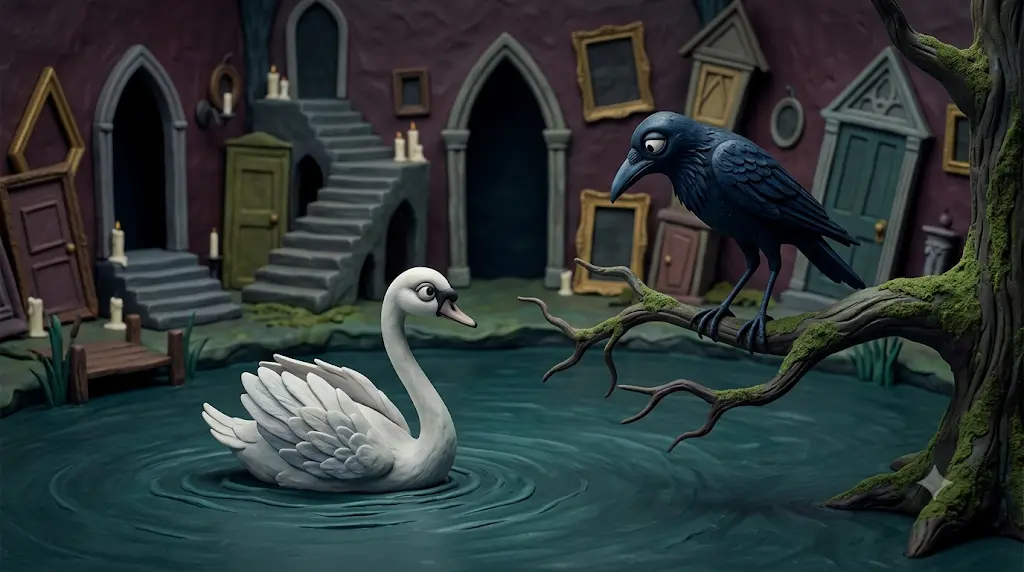
Once upon a time, in the heart of the Whispering Woods, lived a Raven named Barnaby.
Barnaby was a clever bird. He could solve puzzles, mimic the sound of the wind, and find the shiniest bottle caps hidden in the grass. His feathers were a deep, glossy black, the kind of black that looked like a velvet sky just before the stars come out. But Barnaby didn’t like his feathers. He thought they were “dull” and “dusty.”
One afternoon, Barnaby flew over to Mirror Lake. There, gliding across the water like a silent, floating cloud, was a Swan named Seraphina. Her feathers were so white they practically glowed, reflecting the sunlight in a way that made Barnaby’s eyes ache with jealousy.
“It’s not fair,” Barnaby croaked to a nearby squirrel. “She looks like a piece of fallen moon. I look like a piece of burnt toast.”
Barnaby watched her closely. He noticed Seraphina spent her whole day dipping her neck into the cool water and nibbling on soft green weeds. He came to a very strange idea: it must be the water.
“If I wash myself enough,” Barnaby thought to himself, “and eat only what the water provides, surely this black soot will rinse off, and I’ll be as bright as a diamond.”
The next morning, Barnaby packed up his things (which was mostly just his favourite pebble) and moved from his cosy oak tree down to the soggy edge of the marsh.
He began to scrub. He splashed, and he dived, and he dunked. He spent hours rubbing his wings with his beak, expecting to see a flash of white underneath. But every time he dried off, he was just as black as before, only now, he was also very, very cold.
Barnaby was used to a hearty diet of crunchy beetles, sweet berries, and the occasional leftover sandwich crust from a hiker. Now, he forced himself to eat slimy pondweed and bitter water lilies.
“It’s basically a salad,” he tried to tell his rumbling stomach. “Very trendy. Very healthy.”
But the pondweed didn’t taste like berries. It tasted like old socks and mud.
Days turned into weeks. Barnaby became a permanent fixture at the lake, but he wasn’t the majestic sight he hoped to be. Because he was a raven and not a swan, his feathers weren’t waterproof. He stayed damp and shivering.
Even worse, the “lake diet” was making him weak. He grew thinner and thinner. His once-strong wings felt like heavy lead. One evening, as the sun began to set, Barnaby looked at his reflection. He wasn’t white. He was just a very tired, very skinny, very grey-looking version of himself.
He realised, too late, that he had traded his strength, his forest home, and his joy for a colour that didn’t belong to him. He had tried to change his nature, but nature has a way of staying exactly what it is.
Barnaby took one last look at the stars, the only things that truly shine against the black of night, and realised that maybe, just maybe, being the colour of the midnight sky wasn’t so bad after all. But his wings were too tired to carry him back to the woods.
The moral of the story: you can change your clothes, your hair, or where you live, but you cannot change the wonderful thing you were born to be. A raven is meant for the sky, and a swan is meant for the lake. Both are beautiful, but only when they are themselves.