Once there was a king who had a beautiful garden, and in that garden grew a tree that bore golden apples. The apples were counted every day, and as soon as they began to ripen, the king noticed that every night one of them went missing.
The king was very angry indeed, and he ordered the gardener to keep watch all night beneath the tree.
The gardener sent his eldest son to do the watching. But at midnight the young man fell asleep, and in the morning another apple was gone. So the second son was sent. He too fell asleep at midnight, and another apple disappeared.
At last the youngest son offered to keep watch. His father did not want to let him — he was afraid something might happen to the boy — but in the end he agreed.
The youngest son lay down under the tree and waited. As the clock struck midnight, he heard a rustling in the air above him. Down flew a bird of pure gold, and it was just about to snatch an apple when the gardener’s son sprang up and loosed an arrow at it.
The arrow did the bird no harm. But it knocked loose a single golden feather, which drifted down as the bird flew away.
The feather was brought to the king in the morning, and when his council saw it they all agreed that it was worth more than the whole wealth of the kingdom.
But the king said, “One feather is not enough for me. I must have the whole bird.”
The gardener’s eldest son set out first, thinking he would find the golden bird easily enough. He had not gone far when he came to a forest, and at the edge of it he saw a fox sitting. He took out his bow and took aim.
“Do not shoot me,” said the fox, “and I will give you good advice. I know you are looking for the golden bird. Tonight you will come to a village with two inns. One will look very fine, and the other will look poor and shabby. Stay in the shabby one.”
“What could a fox possibly know?” thought the eldest son, and he shot at it anyway — and missed. The fox ran off into the trees.
That evening the young man reached the village. In the fine inn there was singing and dancing and laughter. The other inn looked dirty and miserable.
“I should be a fool to stay in that place,” he thought, and he went into the fine one. He ate and drank, and before long he had forgotten all about the golden bird and his journey altogether.
Time passed, and when the eldest son did not return, the second son set out. He met the fox too, and was given the same advice. But when he reached the village, his brother was leaning out of the window of the fine inn, calling him to come in. The second son could not resist, and he forgot the bird and his country just as his brother had.
More time passed, and now the youngest son wished to go out into the world to find the golden bird. His father did not want to let him go, for he loved his youngest son dearly and was afraid of losing him too. But the boy would not rest until he had his father’s blessing, and at last it was given.
When he reached the forest, he met the fox, who gave him the same good advice as before. The youngest son thanked him kindly, and did not try to harm him as his brothers had.
“Sit upon my tail,” said the fox, “and you will travel faster.”
So the boy sat down, and the fox ran — over hills and over stones, so fast that the wind whistled through their hair.
When they reached the village, the boy did exactly as the fox had told him and spent the night in the shabby inn.
In the morning the fox met him again as he set out.
“Go straight on until you come to a castle. In front of it you will find a great many soldiers, all fast asleep and snoring. Pay them no attention. Go inside until you find the room where the golden bird is kept in a wooden cage. Beside it there will stand a beautiful golden cage. Do not put the bird into the golden cage, or you will regret it.”
Then the fox stretched out his tail, the young man sat down, and away they went, over hills and stones, with the wind whistling through their hair.
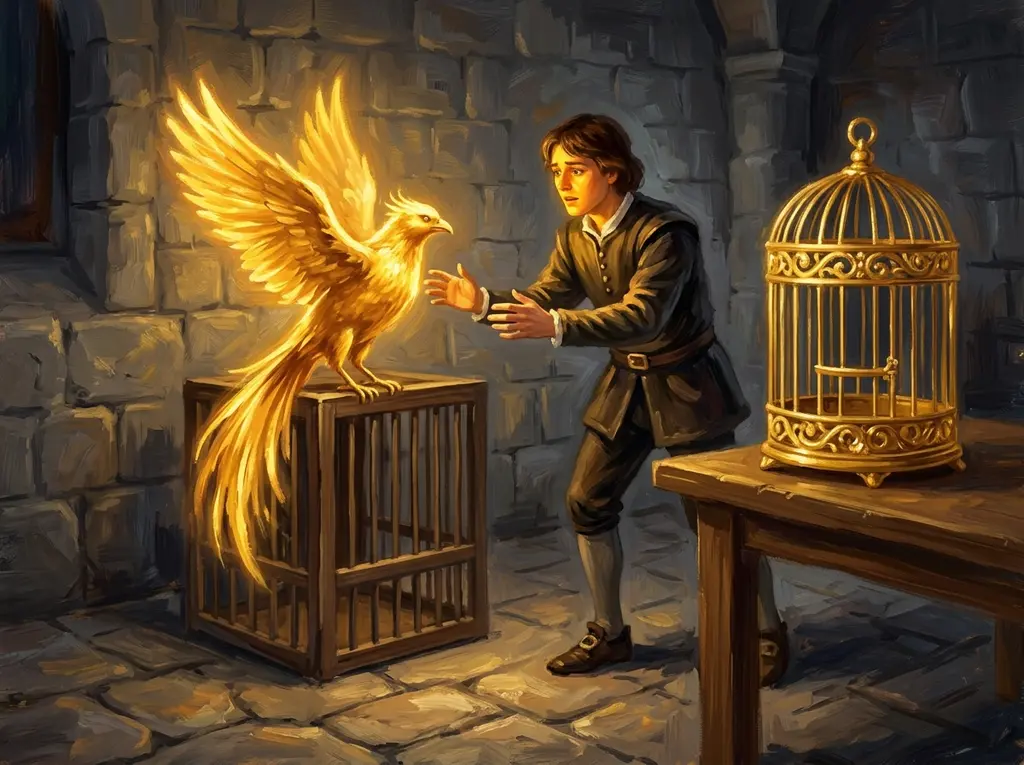
Everything was as the fox had said. The young man walked into the castle and found the room, and there was the golden bird in its plain wooden cage, and beside it the beautiful golden one. The three stolen apples lay close by.
It would be ridiculous, the boy thought, to leave such a magnificent bird in this shabby old cage.
He opened the door and lifted the bird across.
The bird let out a shriek that split the air. Every soldier in the courtyard woke at once, and the boy was seized and dragged before the king.
The next morning the court judged him and sentenced him to death — unless he could bring the king the golden horse, which ran as fast as the wind. If he could, he would be given the golden bird as his reward.
With a heavy heart the boy set out again. And there, suddenly, was the fox.
“You see what comes of not listening to me,” said the fox. “Still, I shall help you. Go straight on until you come to the castle where the horse is kept. The groom will be lying there asleep. Take the horse — but be sure to put the old leather saddle on him, and not the golden one hanging nearby.”
The boy sat on the fox’s tail, and away they went, over hills and stones, with the wind whistling through their hair.
Everything was as the fox had said. The boy found the horse. But when he saw the golden saddle gleaming on its hook, he thought it a shame to put a battered old leather one on so fine an animal.
The moment he lifted the golden saddle, the groom woke and shouted, and every guard in the castle came running, and the boy was taken prisoner once more.
The next morning he was brought before the court again and sentenced to die. But the king said he might be spared, on one condition: he must bring back the beautiful princess from the golden castle.
Once again the boy set off, and once again the fox found him.
“Why will you not listen to me?” said the fox. “Still, I shall tell you how to find the princess. Go straight on, and in the evening you will reach a castle. At midnight the princess will walk out to the bathing house. Go to her and give her a kiss, and she will come away with you. But do not let her say goodbye to her parents, or you will be in trouble.”
The fox stretched out his tail, and away they went, over hills and stones, until the wind whistled through their hair.
Everything happened just as the fox had promised. At midnight the boy met the princess, and kissed her, and she agreed to come away with him.
But then she began to beg him, with tears running down her face, to let her say goodbye to her mother and father. He refused. She wept, and went on weeping, until at last he gave in.
The instant she went in to her parents, the guards woke, and the boy was taken prisoner yet again.
The next day the king told him he might have the princess after all, on one condition. There was a great hill blocking the view from the king’s window, and the boy must clear it away within eight days.
The boy dug and dug. After seven days he had barely made a mark on it.
Then the fox came.
“Lie down and sleep,” he said. “I shall do the work for you.”
In the morning the hill was gone. The boy went to the king, who had no choice but to keep his promise.
Then the fox came to him again.
“Now we shall take the princess, and the horse, and the bird. This is what you must do. When you go to the king and hand over the princess, mount the golden horse. Shake hands with everyone there — and last of all with her. Then pull her up onto the horse behind you and ride away as fast as you can.”
Everything went exactly to plan, and away they went with the princess, the horse, and the bird still to come.
When they reached the place where the bird was kept, the fox said, “I shall wait here with the princess while you go in. When the king brings the bird out, say that you wish to look at it closely, to be certain it is the true golden bird. And once it is in your hands — ride.”
The boy did as he was told, and away the three of them went.
Then the fox said something strange.
“Now you must kill me, and cut off my head and my feet.”
But the boy refused.
“Then at least be careful,” said the fox. “Do not save anyone from the gallows, and do not sit down beside any river.”
That, thought the boy, is easy enough advice to follow.
He rode on with the princess until he came to a village where a crowd had gathered. He asked what was happening, and was told that two men were about to be hanged.
When he came closer, he saw that the two men were his own brothers, who had turned to robbing.
He asked whether they could be saved. Only, said the people, if someone paid all their debts. Without stopping to think, the boy paid every penny, and the three of them went on together.
They came at last to the forest where the fox had first met them. It was cool there, and pleasant.
“Let us rest by the river and eat,” said the brothers.
The boy agreed — and sat down beside the water, forgetting the fox’s warning entirely.
In an instant his brothers had shoved him in. They took the princess, the horse, and the bird, and rode home to the king, and told him they had won all three by their own hard work.
There was great celebration at the court. But the horse would not eat, and the bird would not sing, and the princess wept all day long.
The youngest son had fallen to the bottom of the river, which by good fortune was almost dry. He was badly bruised, and the bank was too steep for him to climb.
Then, once more, the fox came.
He scolded the boy roundly for not listening. “Still,” he said, “I cannot leave you down there.” And he helped him out, and warned him that his brothers had set a watch to kill him if he showed his face in the kingdom.
So the boy dressed himself as a poor man and walked into the king’s court.
The moment he stepped through the door, the horse began to eat. The bird began to sing. And the princess stopped crying.
The boy told the king everything that had happened, and his brothers were punished for what they had done. The princess was given back to him, and when the old king died, the boy became king in his place.
Long afterwards, he went walking in the forest, and there he met the fox again.
And the fox asked him, with tears in his eyes, to kill him and cut off his head and his feet.
At last the boy agreed. And in that very moment the fox was transformed — into a man. He was the princess’s own brother, who had been under a spell for many long years.