Every year, when the days grew short and the air turned cold over the meadows of Europe, a small bird called a barn swallow would begin a very long journey.
His name was Hirundo, and he had been making this journey his whole life. He flew south and east, across mountains and seas, from the cool green countries where forget-me-nots grew beside streams, all the way to the warm tropical lands where the rain fell heavy and the soil was rich and red.
It was a journey of thousands and thousands of miles, and Hirundo made it twice every year, once there, once back, because that was what swallows did. They followed the warmth. They chased the summer, so that no matter where they were, the sun was always shining.
Hirundo had seen a great deal of the world from up high. He had seen deserts and forests, mountains capped with snow, and oceans so wide that there was no land in any direction for days. He had seen cities and villages, rivers and lakes, and more flowers than he could ever count.
But of all the flowers he had seen, only one had ever spoken to him.
It happened on a spring morning in Germany, beside a stream that ran through a meadow full of buttercups and clover. Hirundo had stopped to drink, and there, half-hidden beneath a dock leaf at the water’s edge, was the smallest blue flower he had ever seen.
“Hello,” said the flower.
Hirundo nearly fell off his perch. In all his years of flying, no plant had ever said a word to him. Trees creaked. Grasses rustled. But they didn’t talk.
“You can speak?” he said.
“Only when someone is close enough to listen,” said the flower. “Most people walk right past me.”
Hirundo looked at her. Five tiny petals the colour of a pale winter sky, a centre as yellow as a drop of sunlight. She was so small that a single fallen leaf could have hidden her completely.
“What’s your name?” he asked.
“Forget-Me-Not,” she said. And then she told him the story. How God had walked through the garden naming every plant, how He had nearly left without seeing her, and how she had found her voice at the very last moment and called out.
Hirundo listened without interrupting. When she finished, he ruffled his feathers and said, “That’s a good name. And a brave thing to do.”
“I didn’t feel brave,” said Forget-Me-Not. “I just didn’t want to be forgotten.”
“Same thing, sometimes,” said Hirundo.
He drank from the stream, preened his wing feathers, and prepared to leave. His journey south was waiting.
“Where are you going?” asked Forget-Me-Not.
“The Philippines,” said Hirundo. “Or somewhere near there. Wherever the warmth takes me.”
“Will you remember me?”
Hirundo looked back at her. “With a name like yours? How could I not?”
And he flew.
The journey took weeks. Hirundo crossed the Alps, soared over the Mediterranean, rode the winds along the coast of Africa, and then turned east over the Indian Ocean. He flew through rainstorms and cloudless skies, through headwinds that pushed him backward and tailwinds that carried him faster than he could have flown on his own. He slept in trees he would never see again and drank from rivers whose names he would never know.
At last, he reached the Philippines.
The air was different here. Heavy, warm, sweet with the smell of ripe fruit and wet earth. Everything was greener and louder than the meadows he had left behind. Insects buzzed in thick clouds. Frogs sang from every ditch. The trees were enormous. Coconut palms and banana plants and mangoes so tall that their branches blocked out the sky.
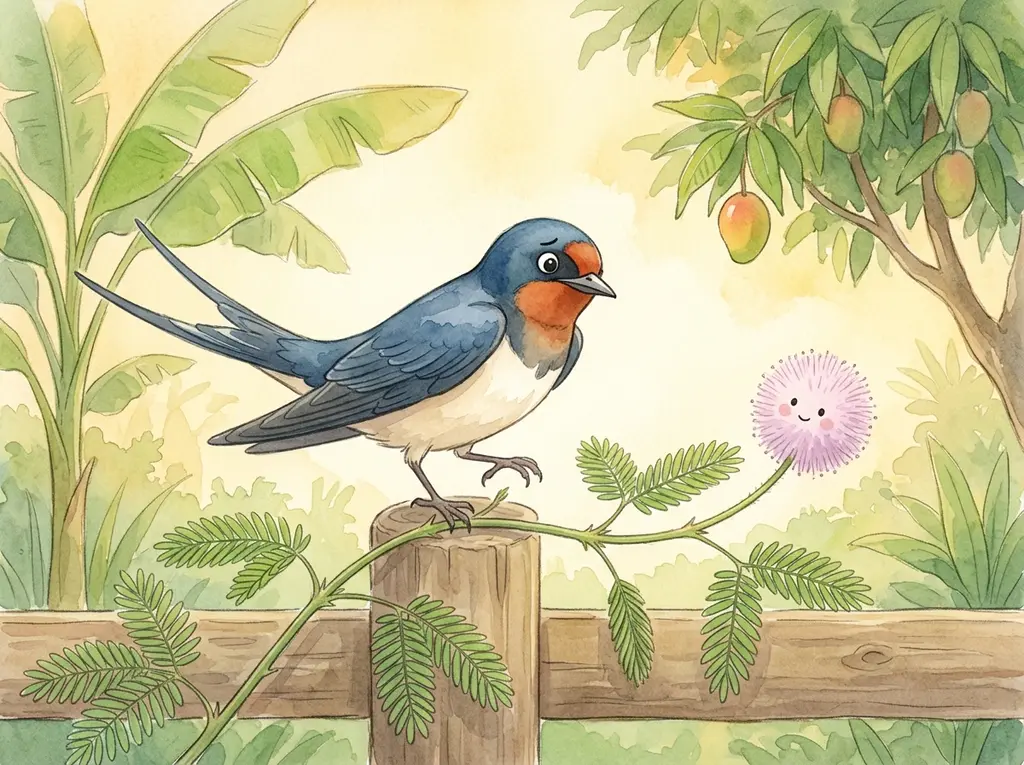
Hirundo was hungry. He spotted a patch of low-growing plants near a wooden fence, the kind of place where beetles and ants liked to hide, and swooped down to hunt. He landed clumsily, his feet catching on the leaves of a creeping plant he hadn’t noticed.
Something strange happened.
The moment his feet touched the leaves, they snapped shut. Not just the ones he had landed on, but the ones next to them, and the ones next to those, folding inward one after another down the whole stem, like a row of tiny doors slamming closed.
Hirundo hopped back in surprise. He stared at the bare stem, then at the curled-up leaves, then at the small, pale pink flower at the tip that had not moved at all.
“Sorry!” he said quickly. “I didn’t mean to… I was just looking for beetles.”
Nothing happened for a long moment. Then, very slowly, one leaf unfolded. Then another. Then a whole row, opening cautiously, the way someone might peek through their fingers after covering their eyes.
“You didn’t frighten me,” said the plant, very quietly. “I just… do that. When someone comes too close.”
“Every time?”
“Every time.”
Hirundo tilted his head. “Why?”
The plant was quiet for a while. When she spoke again, her voice was barely louder than the breeze through the grass.
“Because I was a girl, once. A girl called Maria. And I was so shy that when the world became too loud and too frightening, I curled up so tightly that I became… this.”
“A plant?”
“A plant that hides.”
Hirundo settled on the fence post and tucked his feet beneath him. “Can I tell you something? I met a flower, on the other side of the world, who had the opposite problem.”
The leaves opened a little wider.
“She was tiny. Even smaller than you. And she was so afraid of being overlooked that she nearly let God himself walk away without naming her. But at the very last moment, she called out. And do you know what she said?”
“What?”
“Forget me not.”
The touch-me-not was quiet for a long time. Her leaves stayed open, and if a plant could look thoughtful, she did.
“She must have been very brave,” she said at last.
“She told me she wasn’t,” said Hirundo. “She told me she was just afraid. Afraid of being forgotten.”
“I was afraid of being seen.”
“I know,” said Hirundo. “But here’s the thing. She spoke up, and now her name means remember me. You curled up, and now your name means don’t touch me. You both did what you had to do. And the whole world knows both your names.”
The touch-me-not thought about this. A warm breeze moved through the garden, and her leaves swayed gently, wide open, unhurried.
“Will you tell her about me?” she asked. “When you fly back?”
“I will,” said Hirundo. “I’ll tell her there’s a plant on the other side of the world who understands exactly how she feels.”
Now, here is something important to know.
In real life, the forget-me-not and the touch-me-not have never met.
The forget-me-not grows in cool, damp places. Beside streams in England, along riverbanks in Germany, in mountain meadows across Europe where the air is crisp and the summers are mild. She needs cool soil and gentle rain.
The touch-me-not grows in warm, tropical places. In the Philippines, across Southeast Asia, in countries near the equator where the sun is strong and the rain falls hard and heavy. She needs heat and humidity.
They live on opposite sides of the world. They grow in completely different climates. If you planted a forget-me-not in a tropical garden, she would wilt. If you planted a touch-me-not beside a cold mountain stream, she would shiver and die.
They could never share a garden.
But barn swallows really do fly between Europe and Southeast Asia, every single year. They follow the warmth from one side of the world to the other and back again, and they have been doing it for longer than anyone can remember.
So perhaps, just perhaps, a swallow really did carry a story once, from a blue flower beside a stream to a shy plant in a garden. Perhaps the two of them really do know about each other, the way pen pals know about each other. Not by meeting, but by sharing.
One said, “Remember me.”
The other said, “Don’t touch me.”
Both were small. Both were shy. Both were afraid.
And both became unforgettable.