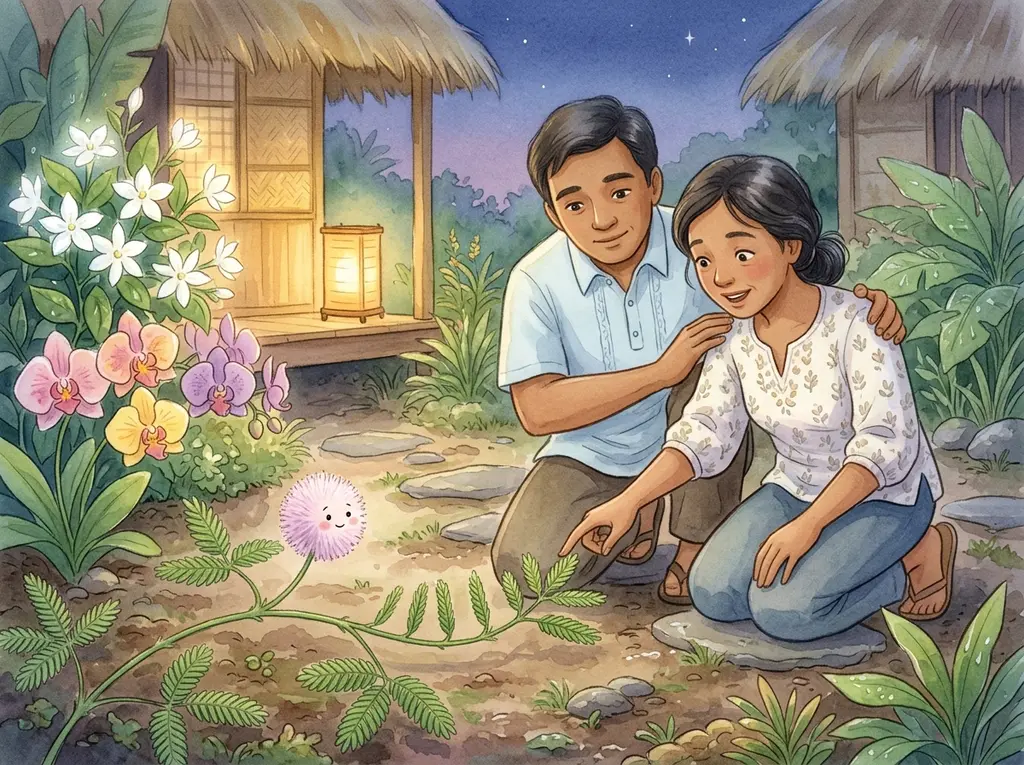
There was a village called Masagana, nestled in a warm green valley in the Philippines. The air there was thick and sweet, heavy with the smell of ripe mangoes, wet earth, and cooking fires. Palm trees swayed above the rooftops, and in the fields beyond the village, rice grew in neat flooded rows that looked like mirrors under the sun.
In that village lived a husband and wife named Dondong and Iska. They had prayed for a child for many years, and at last, their wish was granted. A baby girl, with dark eyes and a smile that could melt even the grumpiest neighbour.
They called her Maria.
Maria was kind. She helped her mother carry water from the well without being asked. She brought mangoes to the old woman who lived alone at the edge of the village. She fed the chickens every morning and sang to them while she scattered the grain, and the chickens, who were not known for their good taste in music, seemed to enjoy it.
But Maria was also very shy.
She would not speak to strangers. If a visitor came to the house, Maria would slip behind the door or hide beneath the table until they left. When other children called for her to come and play, she would peek through the window, shake her head, and run away.
“Come outside, Maria!” they would shout. “We’re playing by the river!”
But Maria would only whisper, “No, thank you,” so quietly that nobody heard, and after a while, the children stopped calling.
The only place Maria felt truly at ease was in her garden, where she had many wonderful plants. She talked to her plants the way she could never talk to people. She told them everything: what she had dreamed about the night before, what she had eaten for breakfast, what shapes she had seen in the clouds. The plants never interrupted. They never laughed at her. They never said, “Why are you so quiet?” or “What’s wrong with you?” They simply grew, and listened, and leaned a little closer whenever she spoke. And Maria was happy there.
Then one day, everything changed. A band of robbers had swept through the towns to the north. Armed men on horseback who took what they wanted, burned what they didn’t, and showed no kindness to anyone who stood in their way. They had already destroyed two villages, and now they were about to reach Maria’s village.
The villagers panicked. Families grabbed whatever they could carry and fled into the forest, into the hills, anywhere. Dondong and Iska looked at each other and knew they had to protect Maria.
“Quick,” Dondong said. “The garden.”
Iska took Maria by the hand and led her to the little garden behind the house, the place she loved most in the world. “Stay here,” Iska said, kneeling in front of her daughter. “Hide among the plants. Don’t move. Don’t make a sound. We’ll come back for you as soon as it’s safe.”
Maria’s dark eyes went wide. “Mama…”
“I know.” Iska held her daughter’s face in both hands. “I know you’re frightened. But you are the bravest girl I have ever known, even if you don’t believe it yet.”
Maria nodded. She crouched behind the bushes, pulling leaves around herself like a blanket, and made herself as small and as still as she possibly could. Dondong and Iska stayed outside to face the robbers.
From the garden, Maria could hear the robbers’ every move. They shouted at Dondong and Iska, smashed open the door, and took whatever they wanted. Maria pressed her hands over her ears and squeezed her eyes shut and tried to think about her orchids, her jasmine, the shapes she had seen in the clouds that morning. She made herself smaller and smaller, curling tighter and tighter, wishing with everything she had that she could simply disappear.
And then, silence.
It lasted a long time. The crickets started up again first, then the frogs, then a night bird somewhere in the forest. The robbers had moved on.
Iska and Dondong ran straight to the garden.
“Maria!”
No answer.
“Maria, it’s safe now. You can come out.”
Nothing. They looked under every bush, behind the trellis, along the fence. They called her name until their voices cracked.
Maria was gone.
But in the exact spot where she had crouched, something new was growing.
It was a low, creeping plant they had never seen before. It had tiny green leaves arranged in neat rows along delicate stems, and at the tip of one stem, a single flower. Small, round, and pale pink, soft as a whisper.
Iska reached down to touch it.
The moment her fingers brushed the nearest leaf, the whole plant shuddered. Every leaf along the stem folded inward, quickly, gently, as if the plant were flinching away from her hand. As if it were curling up. As if it were trying to make itself very, very small.
Iska pulled her hand back. She stared.
Slowly, so slowly, the leaves opened again. One by one, they unfolded, stretching back out flat, as though the plant had taken a deep breath and decided it was safe.
Iska touched it again. The leaves snapped shut.
“Dondong,” she whispered. “Look.”
Dondong knelt beside her. He watched the leaves close and open, close and open. He looked at the pale pink flower, no bigger than a thumbnail. He looked at the spot where Maria had been hiding.
And he understood.
“Makahiya (Maka-hi-ya),” he said softly. The word meant bashful. Shy, easily startled, quick to hide. Everything Maria had ever been.
From that day, Dondong and Iska tended the strange little plant as though it were their daughter. They watered it. They sheltered it from heavy rain. They talked to it the way Maria used to talk to her orchids, telling it their dreams, describing the shapes in the clouds, asking it nothing and expecting nothing back.
And the plant grew. It crept along the warm earth, spreading further than Maria’s little garden, further than Masagana, further than anyone could have imagined. It spread across the whole of the Philippines, across Southeast Asia, across every tropical country where the soil was warm and the rain was heavy. Wherever it went, children found it and discovered its secret: touch the leaves, and they fold shut. Wait a moment, and they open again.
They called it the touch-me-not. The sensitive plant. The shy grass. The sleeping plant. In the Philippines, it kept the name Dondong had given it that evening in the garden.