Long ago, in the place we now call Mexico, there lived a people called the Aztecs. They called themselves the Mexica (meh-SHEE-kah), and that is where the name Mexico comes from. They built a great city called Tenochtitlan (teh-noch-TEET-lan) on an island in the middle of a lake, with tall stone pyramids, busy markets, and gardens that floated on the water.
That was about five hundred years ago, long before anyone had a phone, a car or a light bulb. The Aztec empire came to an end a very long time ago, and the way of life they knew is gone. Mexico City now stands where their great city once was. But their stories did not disappear, because people wrote them down, and that is how we can still read them today.
The Aztecs believed in many gods, and they told stories about them to explain the world around them. Why does the Sun rise every morning? Why does the Moon have shapes on its face? The story you are about to read is one of their answers. It is not how the world really began. It is what the Aztecs believed, and it is a very good story.
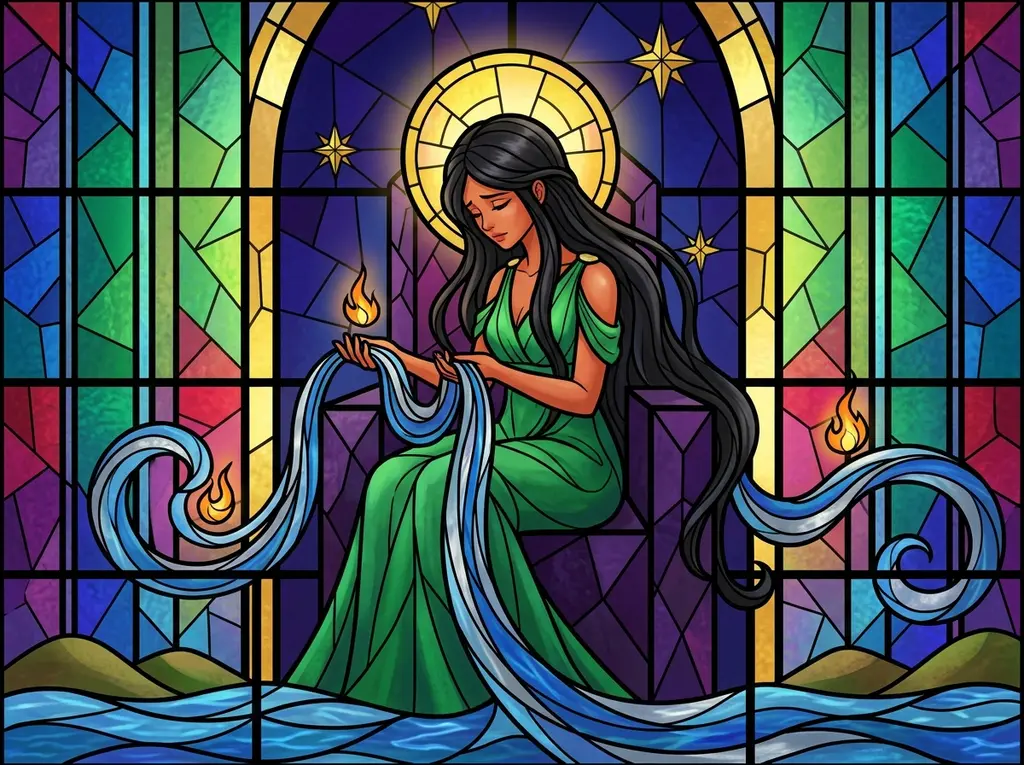
In their story, our Sun was not the first one. Four other Suns had shone in the sky before it, one after another, each for a very, very long time. The fourth Sun was a goddess named Chalchiuhtlicue (chal-chee-OOT-lee-kway). She had copper-coloured skin and wore a dress as green as an emerald. When she smiled, the whole world turned warm and golden, and under her light the very first men and women appeared on Earth.
Chalchiuhtlicue was kind to the people. On cold nights she gave them fire, and families gathered around it to warm their hands, bake flat bread and tell stories. But the other gods were not so pleased. They grew jealous of her.
“Fire is dangerous,” some of them grumbled. “People don’t always use it wisely, you know.” They had a point, because sometimes a careless spark landed in dry grass and a whole field went up in flames. Still, Chalchiuhtlicue never took her gift back.
One night, she was resting in the gloom, tired after a long day of shining. Out of the shadows walked Tezcatlipoca (tez-kat-lee-POH-kah), the god of darkness, who was as black as a sky with no stars. He circled her slowly, with a smirk on his face.
“Look at you,” he said. “So proud of your light. So vain. You only think about yourself.”
“That’s not true,” said Chalchiuhtlicue. “I gave them fire. I only wanted them to be warm, I…”
“Selfish,” said Tezcatlipoca, and he wandered off into the dark, laughing to himself. Chalchiuhtlicue sat very still. Her throat went tight and her eyes began to sting.
She tried to hold it in. One tear slid down her cheek, then another, and then so many that she could not count them. She was a goddess of water, so her tears did not stop at her chin. They poured down and put out her light, like rain on a campfire.
Then the whole sky broke open. SPLOOSH! Rain fell on the Earth in great grey torrents, and the water rose over the fields, over the houses and over the hills, until the land vanished into darkness. Every man and woman was turned into a fish, and they swam away through the flood, right over the places where their villages used to be. Only one family was spared, kept safe so that the human race could begin again.
The Gods Lift the Earth
When the gods saw what had happened, they hurried to fix it. They opened up four roads deep beneath the land, and there they made four giants and some sturdy trees. Then the gods, the giants and the trees all took hold of the Earth together.
“Ready?” called one of the gods. “Heave!” Another god shouted, “Push!” CREEEEAK! The land groaned and shuddered. Water streamed off its sides and away, and slowly, slowly, the Earth rose up. At last the gods managed to fasten it firmly to the sky, so it could never fall again.
But the world was still dark. There was no dawn, no dusk and no sunny afternoons, only gloom from morning to night. Worse still, the pools and puddles left behind were Chalchiuhtlicue’s tears, and they were salty. Nobody could drink them.
Usually, the Sun lifts water up into the sky, where it turns into clouds and comes back down as fresh rain. But there was no Sun to do it, so the salty tears just sat there, cold and still.
The Council at Teotihuacan
The gods gathered at Teotihuacan (tay-oh-tee-wah-KAHN), which means Place of the Gods. They argued loud and long. Some wanted this, some wanted that, and nobody listened to anybody. In the end, they all agreed on two things. There had to be a new Sun, the fifth and final one. And there had to be moonlight to keep watch while the Sun was resting.
“Good,” said an old god at the back. “But who’s going to do it?” Nobody answered. The four Suns before had all faded away, and this one had to be different. Whoever became the Sun would have to make a sacrifice.
In this story, sacrifice does not mean anything sad or scary. It means giving up your old body so you can become something new and much bigger. Think of a caterpillar that wraps itself up and comes out as a butterfly. It leaves its old body behind, but it is still itself, only different. A god who chose this would change their form and become a Sun, and shine forever. It would not be the end of them. They would still be alive, only high up in the sky, where they would light the whole world.
The gods shuffled their feet and looked at the floor. Some coughed. One suddenly found something very interesting on his sandal.
Then a voice rang out. “I’ll do it!” It was Tecuciztecatl (teh-koo-seez-TEK-katl), the god of snails and worms. He was rich and strong, and he wore a golden collar that flashed in the gloom. He was also very, very vain. He imagined everyone looking up at him every single day, saying how wonderful he was.
“I’ll be the Sun,” he said, puffing out his chest. “Everyone will look at me.” The gods nodded, but they still looked uneasy. There had to be a second sacrifice, one for the Sun and one for the Moon, and nobody else stepped forward. Slowly, one by one, the gods turned their heads. Their eyes settled on the smallest goddess in the room, sitting alone in a corner.
Her name was Nanahuatzin (nah-nah-WAHT-zin), but everyone called her Little Nana. She was plain and humble, and the other gods hardly ever noticed her at all. Now every single one of them was looking straight at her, and the whole hall was waiting.
To be continued…