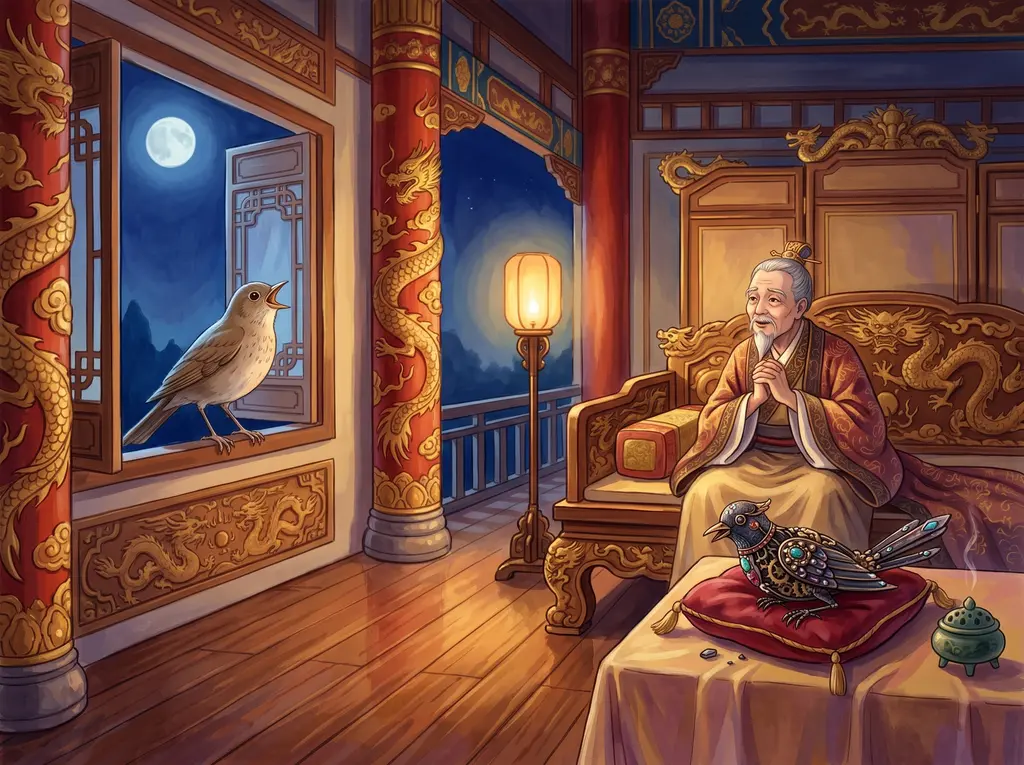
A long, long time ago, in ancient China, there lived a mighty emperor. His palace was grand, filled with marble floors, tall red pillars, and golden dragons carved into the doors. People from every corner of the land brought him treasures — silk as soft as clouds, jade that shone like the moon, and jewels that sparkled brighter than the stars. But none of these made the emperor’s heart truly happy.
One day, word reached him of something marvellous in his own palace gardens. It was not a gem, nor a strange invention, but a little bird, a thrush, whose song was said to be more beautiful than any instrument in the land.
The emperor was curious. “Bring me this thrush at once,” he commanded.
So his servants searched the gardens, until finally they found a small, brown bird sitting quietly on a branch. It looked plain, so ordinary that no one would have guessed it was special. But when the thrush opened its beak and began to sing, the air shimmered with the sweetest melody. It was soft and pure, like silver bells mixed with the whisper of the wind. The emperor listened, and for the first time in many years, tears rolled down his cheeks, not of sadness, but of joy.
“This,” said the emperor, “is the most precious treasure of all.”
From that day on, the thrush was given a place of honour. It perched near the emperor’s bed, singing morning and night. Its song lifted the emperor’s spirits, calmed his worries, and even eased his illnesses.
But one day, a new marvel arrived at the palace gates: a mechanical bird made of gold and jewels. It glittered so brightly that everyone gasped. When wound up, it sang a tune, sharp and loud, with tiny metal whistles hidden inside. The emperor was enchanted. “How clever! How splendid!” he exclaimed. “This bird never tires. It will sing whenever I please.”
And so, slowly, the real thrush was forgotten. The little bird flew away into the garden, and the jewelled machine was placed beside the emperor’s bed.
At first, the mechanical thrush was impressive. Courtiers applauded, and the emperor boasted about it to visitors. But after many months, the gears began to wear down. The song grew harsh and unpleasant. Finally, one night, the bird broke altogether.
The palace grew silent. The emperor, who had relied so much on the songs, fell gravely ill. His doctors shook their heads. “We fear the end is near,” they whispered. Even the emperor’s heirs began to argue over who would take the throne.
Then, as the emperor lay weak and pale, a sound drifted through his open window. It was gentle at first, like a secret carried on the night air. The real thrush had returned! Perching on the sill, it began to sing. The song was no longer just sweet, it was full of kindness, hope, and life.
Tears streamed down the emperor’s face again. His heart grew lighter. “Dear thrush,” he whispered, “I had forgotten you. Yet you return to me in my darkest hour.”
The thrush kept singing through the night, and by morning, the emperor was sitting up, stronger than before. His cheeks glowed with colour, his eyes sparkled, and everyone in the palace was amazed.
From that day on, the thrush never left the emperor’s side. The mechanical bird was set aside, and the little plain thrush was loved and honoured as the truest treasure of the kingdom.
And so the emperor learned a lesson: sometimes the most valuable things are not the shiniest or the grandest, but the ones that bring warmth, joy, and love to the heart.
And if you listen very carefully on a quiet night, maybe you too can hear a thrush singing somewhere nearby, reminding us that real beauty often hides in the simplest of things.