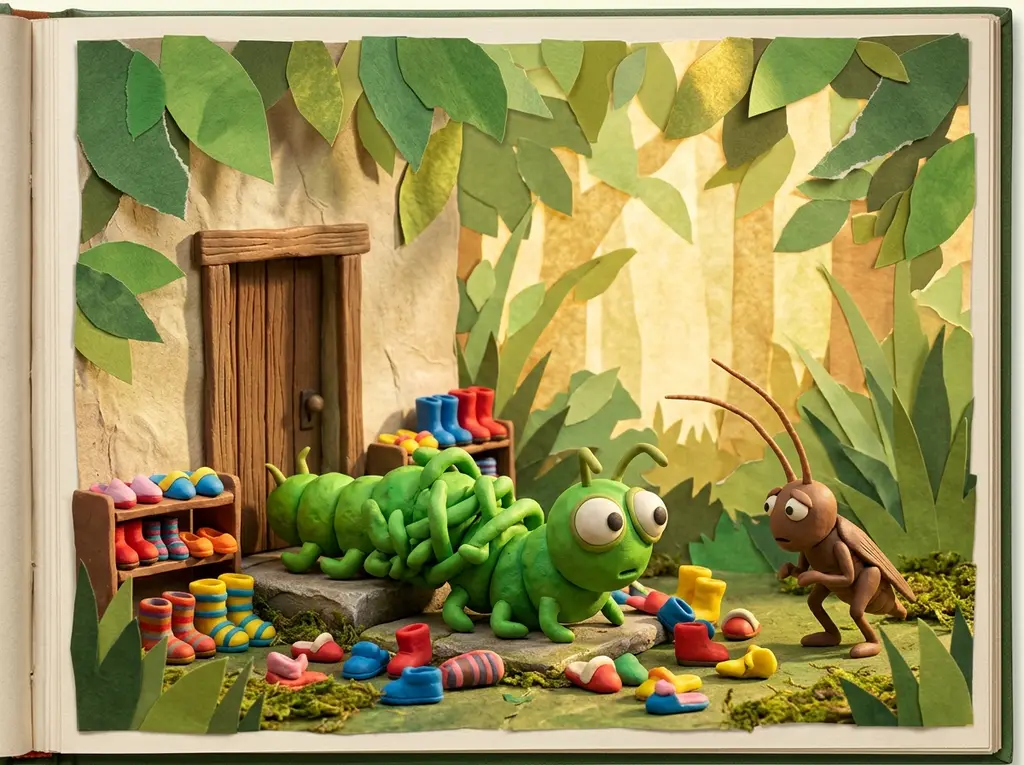
Once upon a time, in a green and leafy meadow, there lived a very busy caterpillar named Crispin.
Crispin had a strict routine. Every morning, as soon as the sun peeked over the trees, he left his little house to look for the tastiest leaves in the meadow. Crunch, munch, slurp, he loved his leafy meals.
But before he could go anywhere, Crispin had to put on his shoes. One shoe, two shoes, three shoes, all the way to one hundred shoes! It took him so long that sometimes the sun was already high in the sky before he finally stepped outside.
When he came back home in the evening, after a day of chewing and chomping, he had to do the same thing again: take off all his shoes. One shoe, two shoes, three shoes, oh my! No wonder Crispin was always busy.
His neighbour, a cheerful little cricket named Tico, watched him every day. At first, Tico thought it was funny, but after many days of waiting for Crispin to get ready, he couldn’t hold it in any more.
“Tch-tch-tch!” chirped Tico one morning. “Crispin, why on earth do you wear shoes on every single foot?”
Crispin looked up, surprised. “Oh, because I don’t like my feet touching anything else. I like them neat and tidy!”
“But why does it take you so long just to leave the house?” Tico asked.
“Well,” Crispin sighed, tugging at a shoelace, “because I have a hundred feet, and each one needs a shoe!”
Tico twitched his antennae thoughtfully. Then he asked, “How do you even know which foot to step with first? And then the next? And then the next after that?”
Crispin froze. His eyes went wide. His little jaw dropped. “I don’t know!” he stammered.
He had never thought about it before. Walking had always been so natural, step after step, shoe after shoe. But now that the question had been asked, Crispin couldn’t stop thinking about it.
The very next morning, when he tried to leave his house, he tripped right at the door! Thump! Flop! Down he went, his legs all tangled up.
“Oh no!” cried Crispin. “Which foot first? Left? Right? Middle?”
The more he tried to remember, the more he forgot the natural rhythm of walking. Soon, every step felt clumsy. He tripped over his own feet, bumped into stones, and once even slid down a blade of grass like a slide.
“Oh dear, oh dear,” he sighed. “I’ve forgotten how to walk.”
For many days Crispin struggled. He felt sad and slow. But then one evening, as the fireflies lit up the meadow, Tico came hopping by.
“Crispin,” Tico said gently, “maybe you don’t need to think about it so much. Try listening to your feet. Let them do what they already know.”
“Listen to my feet?” Crispin tilted his head.
“Yes,” chirped Tico. “Don’t count, don’t plan, just wiggle, and let them lead the way.”
So Crispin closed his eyes. He took a deep breath. Slowly, one of his feet wiggled forward. Then another. And another. Before he knew it, his hundred little feet were moving together, just like before!
Tap-tap-tap, pat-pat-pat! He scurried across the meadow without tripping.
“I did it!” Crispin cheered.
From that day on, Crispin stopped worrying about which foot came first. He still wore his hundred shoes, because he liked them neat and tidy, but he no longer wasted time thinking about every step. He trusted his feet, and they carried him wherever he needed to go.
And every evening, when he sat with Tico under the stars, he would chuckle and say, “Sometimes, the best way to walk is simply to walk.”
And so, Crispin the caterpillar learned that not every question needs an answer: some things are better left to instinct.
The End.