In Georgia, in the olden times, there lived a wise and noble woman, Queen Magdana, who ruled her rich green land justly. When her husband died, her son Rostomel became the sole love of her life. She loved him more than words can convey, and she watched fondly as the tender, callow youth grew into sturdy manhood. Nor was she the only one who thought him handsomer than all others.
Yet as the days ran into years, she began to notice a cloud upon his handsome brow. For no reason she could see, the young man had turned silent and gloomy. No wild gallop over the green hills of Georgia, no wistful song, no passionate black-eyed glance from a dancing maiden, could drive away his dark moods or lift the shadow from him.
Pensive and downcast, he would carry his burden off to some distant corner of the palace grounds and give himself up to melancholy daydreams.
At last the good queen could bear her son’s sadness no longer.
“O my son,” she said, “tell me what painful thoughts are gnawing at your heart. What sorrow drives the smile from your lips?”
“Mother mine,” the prince replied, “I would ask you in return to answer me one question. Where is my father?”
“Your father?” said the queen, surprised. “Why, he died a long time ago.”
“Died? What does that mean?”
“Know, my son,” said the queen, “that we all come from the earth, and one day we must all return to it. The time will come when good Mother Earth takes us back again. That, my son, is what it means to die.”
“I do not understand,” her son replied. “Surely God, who granted us life, did not do so only to take it back again? No. That cannot be. There must be somewhere on this earth a place where life is eternal and people know nothing of death. I shall go and find that place, and seek immortality there. Dear Mother, forgive me for leaving you — but if I stay, I shall surely die of my sorrow.”
In vain did his poor mother beg him to remain. In vain did she weep bitter tears. In vain did she waste away in her grief. Her son would not be moved. One day he embraced her and went on his way in search of eternal life.
For a long, long time the prince wandered through the world and visited many lands, and nowhere did he find a country of immortality.
Then one day he came to a silent, treeless plain. Gazing into the distance, he saw against a clear blue sky a deer standing quite motionless, its horns held high.
As he came near, the deer spoke.
“Young man, what is it you seek in this barren land?”
“I seek a land of immortality,” the prince replied.
“Immortality? There is no such thing,” said the deer. “But look — do you see the boundless blue sky above us? It is my destiny to stand here without moving until my horns reach it. Stay here with me until that distant day, and for all those years, I promise you, you shall be immortal. Only when my earthly task is finished will you die.”
“Oh no,” replied the prince. “Even hundreds of centuries are not immortality. And I want to be immortal. So farewell, my friend.”
On he went, until at last he came to a line of barren rocks that towered so high their peaks pierced the clouds. And on the highest peak of all, above a bottomless ravine, sat an old black crow.
The prince laboured night and day up the jagged mountain until he reached him.
“Why have you come?” the crow asked. “What do you seek on this godforsaken mountain?”
“Immortality,” the young man replied.
“Immortality? There is no such thing,” said the crow. “Look down into the bottomless ravine below me. It is my fate to remain here until I have pecked away every grain of sand and every piece of grit from this mountain, and filled that ravine to the brim. You are welcome to stay with me down the ages until my task is done. For all that time you will be immortal — that I promise you.”
“Oh no,” said the prince. “What are long centuries to me? I seek immortality itself, and one day I shall find it. Farewell.”
Once again he turned his footsteps into the unknown, and after many, many leagues he came at last to the very edge of the world.
Beneath a glorious rainbow, an endless and marvellous ocean stretched out before him. Transparent blue waves capped with trembling snow-white foam splashed upon the sandy shore and lapped gently at his feet. And there in the boundless distance, far, far beyond the rainbow’s end, through a golden, rose-coloured haze, a wondrous light was shining.
It seemed to be beckoning to him. It caressed his soul, and stirred his heart, and drew him towards it.
In an instant the enraptured prince was carried to the far shore. He found himself standing in a glittering palace — and there before him, radiant in the light of a myriad precious stones, stood the most beautiful maiden he had ever seen.
Who she was, he did not know. But the stars and the rays of the sun themselves faded before her brightness, and her voice came to him like the soft rustle of velvet upon a silken couch.
“Welcome, Rostomel, to my eternal realm. I was born on the first day of creation, and I shall remain here until the end of time. As long as you stay with me, and give up all worldly life, death cannot touch you. You shall be immortal. For I am the Beauty of Life.”
Rostomel gladly stayed.
A thousand years passed, and he never tired of her, and never once took his eyes from that wonderful face.
More centuries went by. And gradually, down the long ages, his heart began to ache.
One day he said to her, “Divine Beauty — how many years have passed since last I saw my dear mother, and the green hills and valleys of my native Georgia?”
“Ah,” said Beauty. “I perceive that Mother Earth will not easily give up what is rightly hers. Go, then. Bow down before the universal law, and yield to human destiny. But take this gift in memory of me: two flowers, one purple and one milk-white.
“If you wish to live your life again upon the earth, to feel all the years you have lost in contemplating my beauty — then breathe in the scent of the purple flower. And should you come to understand the beauty of death, then hold the milk-white flower to your face and inhale its fragrance deeply.”
Having said farewell to the divine Beauty of Life, Rostomel went back the way he had come.
On his journey home he passed the familiar mountain, and on its summit the old black crow still sat. He called out, and no answer came. He climbed closer, and touched the bird with his hand — and at once its body crumbled into dust.
Looking down, Rostomel saw no sign of the deep ravine at all. It was filled to the brim with sand and grit from the mountain. The old crow had finished its earthly task and won eternal peace.
He went further, and came to the silent plain where the deer had stood. All that remained now was a white breastbone and a sun-bleached skull, from which two great horns reached up through the clouds into the domed canopy of the heavens. Like the crow, the deer too had completed its task, and earned its eternal sleep.
At last Rostomel came home to Georgia.
But what did he find there?
He could not recognise a single person, nor a single thing. Where wilderness had once stretched, there were now villages and bustling towns. Unfamiliar people in unfamiliar dress walked the land, speaking a strange tongue he could not understand. Yet there were the mountains he knew — where he had first seen the light of day, where he had grown up, where he had left his dear mother.
Where, then, was she? Where was the castle in which Queen Magdana had lived and ruled her valiant people?
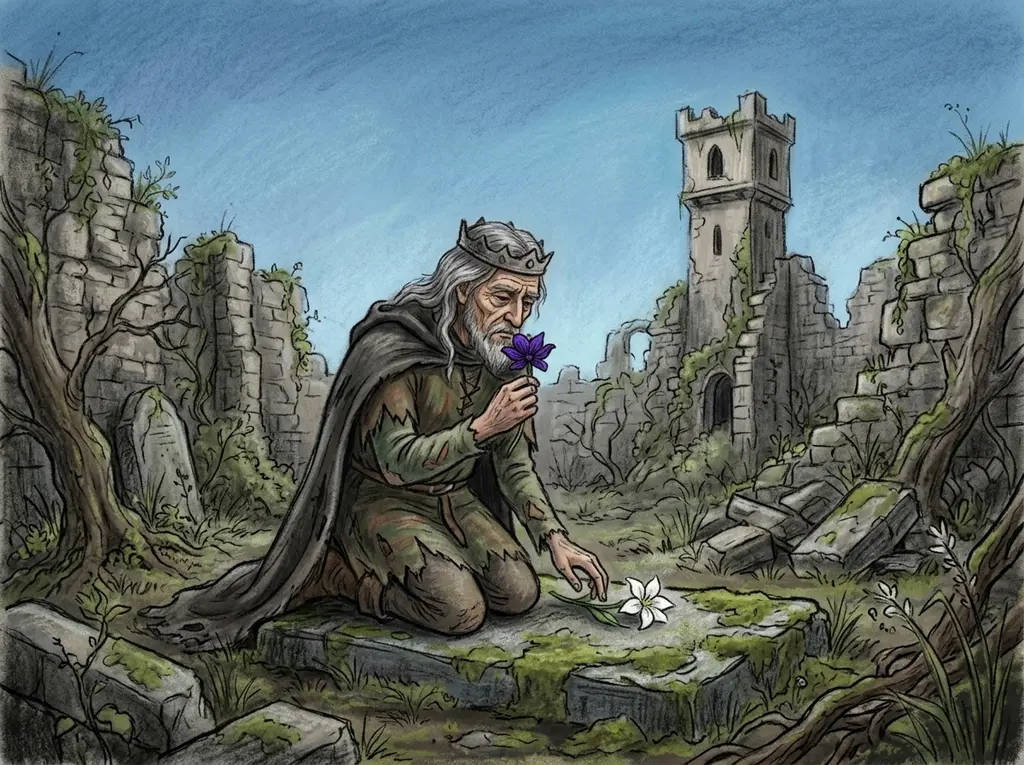
All was wasteland now. All was as silent as the grave, and only slabs of moss-covered stone stood as silent witnesses to the great palace that had once been there. As he drew closer, his heart beating fast, he saw the ancient watchtower still standing tall and straight upon the hill — where fountains had once played, where sweet songs had once sounded, where maidens’ feet had once trodden the grass.
He ran towards it, and came upon an old man bent almost double by the weight of his years, sitting upon a gravestone and murmuring a prayer through trembling lips.
“Tell me, holy father,” said Rostomel, breaking in upon the prayer in his haste, “is this not the place where Magdana once lived — the great and glorious queen who ruled her people so justly? I am her son, and heir to her throne. If my mother is no longer living, then I am now your king and sovereign.”
“Magdana? Magdana?” the old man repeated. “I scarcely understand you, young man. You do not speak our language. Your words are the words of the ancient chronicles — I studied them once, and so I recognise a little of your speech. Magdana, you say? Yes. There is a legend, though I do not know whether it is true, that a great queen lived here a thousand years ago and more. Her name, as I recall, was Magdana. She had a son, so the legend goes, who went away and vanished without a trace. Magdana died of a broken heart, and her kingdom perished soon after her.”
Prince Rostomel stood silent for a long time, and tears of anguish ran down his cheeks. At last he raised his wet face to the heavens and cried out.
“O eternal secret of time! What am I now? Nothing more than a forgotten legend?”
And with that, he took out the purple flower, held it to his face, and breathed in its fragrant scent.
Instantly he aged. He became an old man, weak and bent; his keen eyes turned dull, and his bronzed skin dried and parched over ancient bones. He no longer had the strength even to lift his hand to the pocket where he kept the milk-white flower.
In a hoarse whisper he appealed to the old priest.
“Quickly, father. Take out my milk-white flower and hold it to my face, that I may breathe its fragrance and know at last the mysterious delight of death.”
And Rostomel died.
The people came and returned him to the earth from which he had come, and no one has ever disturbed his sleep since. But upon his grave, every year, there grow two flowers — one purple, and one milk-white.