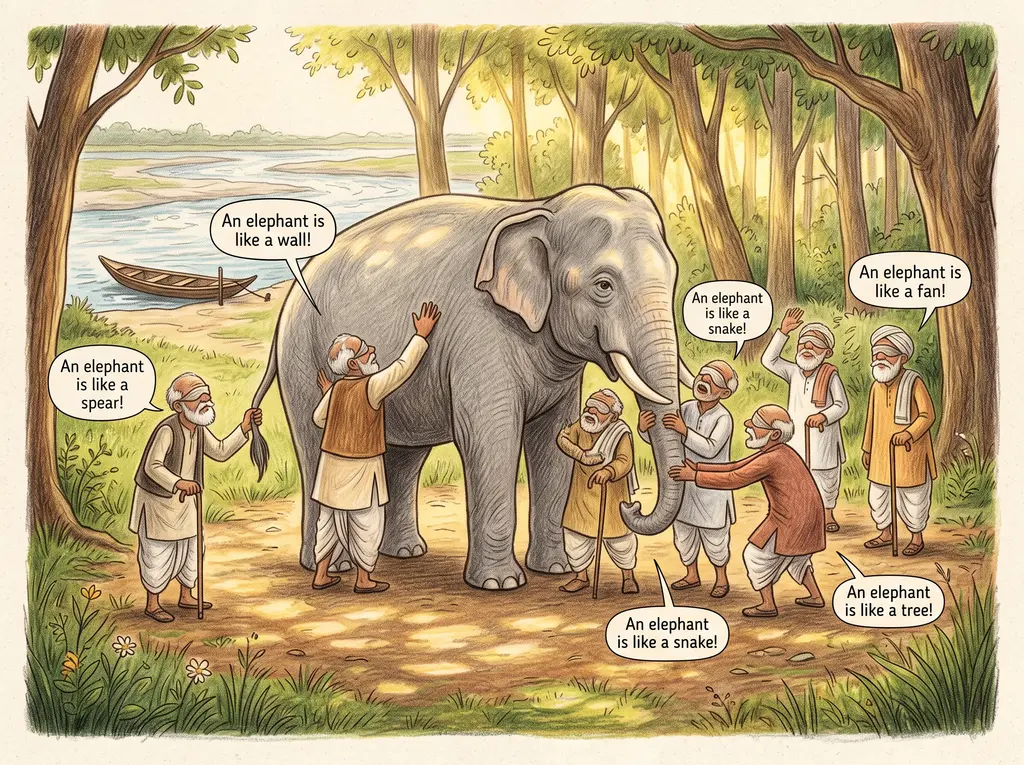
A long time ago, in the valley of the Brahmaputra River in India, there lived six men who loved to boast about their wit and their learning. Though they were no longer young, and though all six had been blind since birth, they would compete with one another to see who could tell the tallest story.
Every evening, when the sun was setting behind the palms and the air was full of wood smoke and spices, one of the old men would begin a new tale.
It might be about how he had spoken with Lord Krishna, whom he claimed to have met one day while walking in the forest. He would tell how Lord Krishna had appeared in a dazzling blue glow, playing a merry, enchanting tune upon his flute, and had granted him wisdom above all other mortals.
The second blind man might tell of the bulbul bird, who came by his brilliant crimson breast on the day he saw a tiger fleeing from a porcupine. The sight was so funny that the bird burst out laughing — and laughed so hard that the blood ran all down his front.
Not to be outdone, the third would cough and click his tongue, as though holding a conversation with a lizard on a mud hut wall. Then, so inspired, he would tell of the days of good King Vikramaditya, who saved a brahmin’s child and married a humble peasant girl.
After him came the fourth, and then the fifth, and then the sixth, each story more fantastic than the last. And so it went on, night after night, the six of them passing the time with harmless boasting.
One day, however, they fell to arguing in earnest. The subject of their dispute was the elephant. Since all six were blind, not one of them had ever seen the mighty beast of whom so many tales were told, and each was quite certain he knew best.
To settle the matter once and for all, they decided to go and find an elephant.
They hired a young guide named Dookiram and set out early one morning, walking in single file along the forest track, each man resting his hands on the back of the man in front. It was not long before they came to a clearing where a huge bull elephant, quite tame, stood contemplating his menu for the day.
The six blind men grew very excited. At last they would satisfy their curiosity. One by one, they took their turn to investigate the elephant’s shape and form.
The first approached boldly — rather too boldly. He stumbled over a log and went sprawling against the beast’s broad side.
“Oh, my brothers,” he cried out at once, “it is as sure as I am wise that this elephant is like a great mud wall, baked hard in the sun!”
The second was more cautious. When his turn came, he edged forward with his hands outstretched, feeling his way. Coming from the front, his hands soon met two long, sharp objects that curved high above his head. They were the elephant’s tusks.
“Now, my brothers,” he exclaimed, “I can tell you exactly what shape this elephant is. He is like a spear!”

The others smiled in disbelief.
Now it was the turn of the third, who approached from the rear. Carefully he stepped forward, his hands waving in the air, until he touched the elephant’s tail. Seizing it in both hands, he felt the strong bending twine of it and the coarse fibres at the tip.
“Why, dear brothers, can you not see?” he shouted. “This elephant is very much like a rope!”
The fourth stepped nimbly forward from the front, and soon his groping hands closed on a long, squirming thing that curled about his waist. It was, of course, the trunk.
“Ha! I thought as much!” he declared. “This elephant is like a serpent!”
The others snorted their contempt.
The fifth, a tall old fellow with a turban and a white beard, chanced to touch the creature’s ear.
“Good gracious, brothers,” he called out, “even a blind man can see what the elephant resembles most. Why, he is mighty like a fan!”
That brought scoffing laughter from all the rest.
At last it was the turn of the sixth old fellow. Bowed down with age, he came forward slowly, passing beneath the trunk and the tusks, until his head came up against the beast’s stout leg. Feeling it wonderingly with both hands, he called to the others in his wheezy old voice.
“This sturdy pillar, my brothers, feels exactly like the trunk of a great areca palm tree.”
Of course, no one believed him.
Their curiosity satisfied, the six linked hands and followed young Dookiram back to the village. And there, seated beneath a waving palm, they began disputing all over again, loud and long. Each had his own opinion, founded firmly on his own experience, of what an elephant was truly like. Each had felt the elephant for himself, and each was convinced that he alone was right.
And so, in a way, he was. For depending on which part of the elephant a man had happened to touch, every one of the six was partly right — and every one of them, in the end, was wrong.