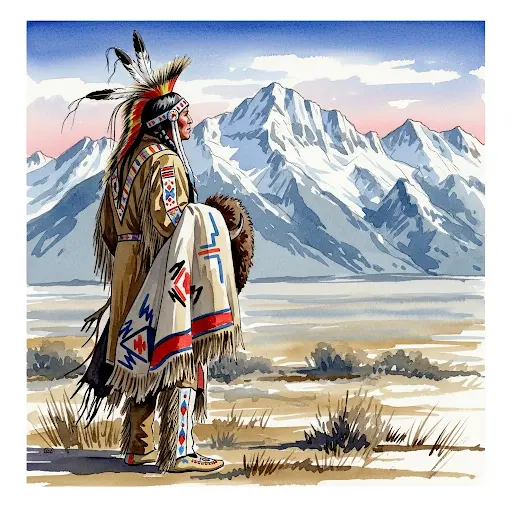
Long ago, when the world was young, there lived a brave hunter named Eye of the Eagle. He was strong and clever, and his eyes were so sharp he could spot a bird in flight miles away. He lived with his tribe near the edge of the Great North Forest.
One summer was hotter and drier than anyone could remember. The rivers shrank, the grass turned brown, and the prairie animals moved away in search of water. Even the rabbits and deer vanished into the distant woods.
But Eye of the Eagle stayed. “I will not give up,” he said. “I must find food for my people.”
One morning, he set out in his canoe, paddling across the wide river. The air was heavy, and storm clouds gathered in the sky. By afternoon, a fierce snowstorm blew in. Snow whirled so thickly that Eye of the Eagle could not see the shore. The world turned white, and even his sharp eyes were blinded.
He paddled on bravely, but soon he lost his way. The cold bit at his fingers, and his strength began to fade.
Just when he thought all hope was gone, he noticed a tiny figure hopping through the snow. It was a small brown rabbit, its fur dark against the shining whiteness.
The rabbit stopped and twitched its nose. Then it turned and hopped a few steps, looking back at the hunter as if to say, “Follow me.”
Eye of the Eagle, desperate for guidance, pulled his canoe onto the snowy bank and trudged after the rabbit. Step by step, the rabbit led him through the storm: across the frozen meadow, past the tall pines bending under their heavy coats of snow, and down a hidden path that twisted like a white ribbon.
At last, the rabbit brought him safely back to the river’s edge, where his canoe lay waiting. The storm began to clear, and the hunter could see the smoke of his tribe’s campfires rising in the distance.
Eye of the Eagle knelt before the rabbit. “Little one,” he said, “you have saved my life. I am a strong hunter, yet today I would have perished without your help. I will not forget your kindness.”
He was so grateful that he chanted a magic prayer of thanks. The words rose into the sky and drifted down like falling snow. As he finished, the rabbit’s fur began to change. From its nose to its tail, the soft brown turned to shining white.
The rabbit looked down at itself in surprise. Its coat now matched the snow perfectly. From that day forward, rabbits in the North wore white in winter, so that no hunter could so easily find them again.
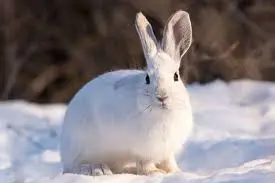
Eye of the Eagle returned to his people with food and wood, and when he told the story, the tribe honoured the rabbit as a symbol of kindness and wisdom.
And so, every winter, when children see the snow-white rabbits darting across the drifts, they remember the day a small creature saved a great hunter.
Moral: even the smallest creature can do a great and noble deed.