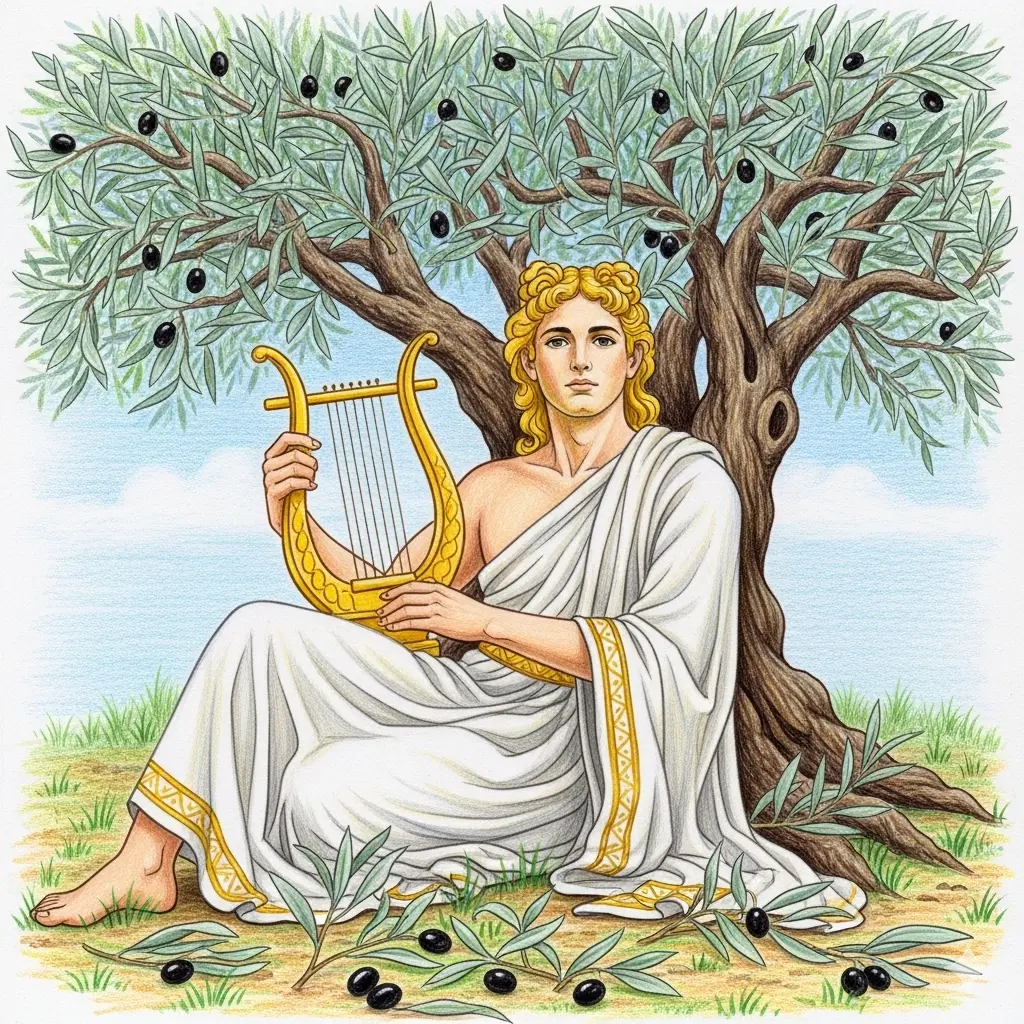
Long ago in ancient Greece, music floated through the hills and valleys like a soft golden mist.
And none played music more beautifully than Apollo, the god of music himself. His fingers danced across his lyre, sending out notes that shimmered in the air and made even the birds stop singing to listen.
Everyone agreed: no one could match Apollo’s music.
But one day, while resting under an olive tree on his island of Delphos, Apollo overheard a rumour from passing travellers.
“There’s a shepherd named Olander,” they whispered, “whose flute music is so sweet that even the sheep gather close to hear.”
Apollo’s eyes narrowed. A mortal rival?
He rose to his feet, sunlight glinting off his golden robe. “Then let him come,” Apollo said. “Let him play for the Muses, and we shall see who is the true master of music.”
Word spread quickly. On the day of the contest, the hills of Delphos were alive with excitement. Fishermen, shepherds, merchants, and travellers gathered in a great amphitheatre carved into the hillside.
The nine Muses, glowing with divine light, took their seats as judges.
First, Apollo stepped forward. He plucked his lyre, and a melody so pure and bright filled the air that even the sea seemed to hush. The audience sighed with delight; some even wept.
Then came Olander, a simple shepherd in a woollen cloak. He lifted his flute, closed his eyes, and began to play.
Soft as a breeze, sweet as honey, his tune drifted out over the crowd. The sheep that had followed him down the hill bleated happily and lay at his feet. Even the Muses leaned forward, smiling.
When Olander finished, the amphitheatre buzzed with awe. The judges whispered to one another, unable to decide.
Was the god truly better than the shepherd?
Apollo’s pride stung like a bee. “Very well,” he said, forcing a smile. “One more test.”
Apollo lifted his lyre and said, “Let us play our instruments the opposite way around!”
Gasps rippled through the crowd. Olander hesitated, but the Muses nodded, they had agreed to judge, after all.
Apollo turned his lyre upside down. To everyone’s amazement, when he plucked the strings, music still poured forth: soft, golden, and flawless.
Then it was Olander’s turn. He turned his flute around and tried to blow through the wrong end. He puffed and puffed, his cheeks red as a pomegranate, but no sound came out.
The crowd murmured. Olander’s face fell. Only then did he realise: Apollo had tricked him.
The Muses looked at each other. Apollo smiled proudly, sure he had won.
But the eldest Muse rose and spoke: “Yes, Apollo, you played beautifully. But you won not by skill. You won by trickery.”
Apollo’s smile faded.
The crowd nodded in agreement. Olander bowed his head, disappointed, but the Muse turned to him and said kindly, “Your music was true and pure. That is what matters most.”
Apollo left without a prize, his pride a little bruised. And Olander returned to his sheep, flute in hand, his heart lighter than ever, because though he had not won, he had played honestly, and the hills would always remember his song.
And so, little one, remember this: winning by trickery is no real victory at all. True skill, played with honesty, is what makes music, or anything else, shine.